

Solar-Thermal Ice Systems Scale-Up Pricing
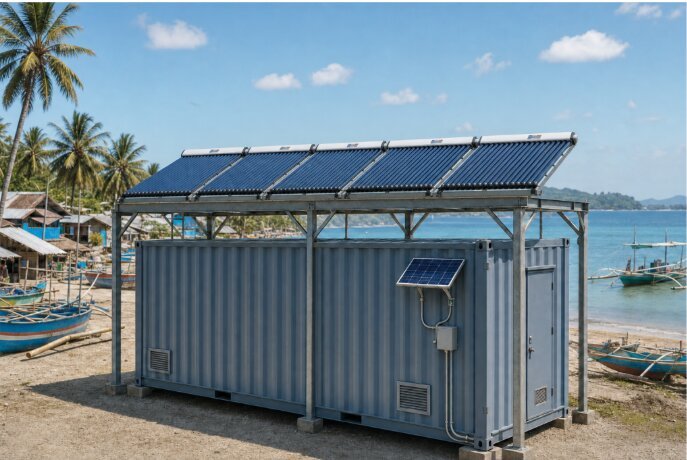
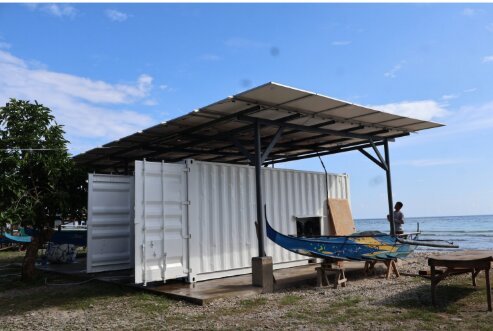
MTD's ammonia-absorption ice system runs on solar heat alone — no compressor, no inverter, no refrigeration-scale battery.
The array is modular: the same design scales from a 5-panel reference unit up to 10, 20, or 50 panels, with installed cost per ton of annual ice capacity falling as scale increases.
Figures below simply divide each system's total installed cost evenly across a 25-year service life — a straight-line amortization with no loan, no interest, and no financing assumptions.
25-Year Straight-Line Amortized Pricing
Compare installed cost, annual ice output, and amortized cost across three array sizes.
| Array Size | Installed Cost | Annual Ice Output (t/yr) | Avg. Daily Output (t/day) | Amortized Annual Cost | Amortized Monthly Cost | Cost per Ton of Ice, Amortized |
|---|---|---|---|---|---|---|
| 10 Panels | $416,448 | 807.1 | 2.21 | $16,658 | $1,388 | $20.64 |
| 20 Panels | $715,552 | 1,614.2 | 4.42 | $28,622 | $2,385 | $17.73 |
| 50 Panels | $1,472,990 | 4,035.6 | 11.06 | $58,920 | $4,910 | $14.60 |
Source: Modern Thermal Design internal engineering sizing model, September 2026 (MTD Ice Sizing Worksheet, “Scale-Up & Amortization” sheet).
Why Cost per Ton Falls as You Scale
Larger arrays spread installed system costs across more annual ice production capacity.
Installed cost at 50 panels vs. $602/ton at 5-panel scale
At 50 panels, 25-year straight-line, no interest
Over 25 years — unlike PV (see below)
UV Solar Thermal Never Degrades — Unlike PV
Modern PV panels lose roughly 0.5–0.7% of rated output every year, cumulating to an estimated 13–20% loss by year 25 — why 25-year PV warranties typically only guarantee 80–87% of original output (NREL; Energy Solutions, 2026).
That decline comes from semiconductor-level wear inside the PV cell itself. MTD’s evacuated-tube UV thermal collectors have no PV cell to degrade, aging instead through discrete, field-repairable wear (tube vacuum loss, coating degradation) with a 15–25+ year typical service life (SRCC OG-100 durability testing).
This sheet assumes 0% output degradation over the full 25-year term — a PV-electric competitor’s output and $/ton economics erode every year, plus a costly battery/inverter replacement around year 10–15 that the MTD thermal array does not require.
Output Degradation Assumed
MTD thermal-array amortization model over 25 years
Actual collector condition, maintenance needs, and service life depend on operating and environmental conditions.
Why Thermal Needs Far Less Solar Field
Matching this array's output with a PV-battery-electric system takes far more collector area.
A representative 19.8 kWp PV-electric plant (36 × 550 W panels) needs about 93 m² (1,001 ft²) of bare module area — roughly 150 m² (1,600 ft²) once racking and row spacing are installed — versus just 13 m² (140 ft²) for MTD's 5-panel thermal array, about 1/7th the collector footprint.
Driving the absorption cycle directly with solar heat is far more area-efficient than first converting sunlight to electricity.
36 × 550 W (~19.8 kWp), 1,001 ft²
5-panel array, 140 ft² — 1/7th the space
Sources: LONGi 550 W datasheet · Maysun Solar — Solar Panel Dimensions.
Efficiency Optimization + Thermal Storage
Bank solar heat during peak sun and discharge it after sunset to extend the daily ice-making cycle.
More Daily Ice Output — Without Adding Panels
Bank solar heat during peak sun and discharge it after sunset to extend the daily ice-making cycle by 2 hours — 9 to 11 hrs — without adding a single panel. Combined with optimistic-case cycle-efficiency performance, this lifts full-array output 63% over baseline on the same 5-panel reference array: 1.11 to 1.80 metric tons/day (403.6 to 657.6 metric tons/year).
1.11 → 1.80 t/day, same 5-panel array
9 → 11 hrs via banked solar heat
Insulated tank + oil charge, 5-panel scale
What the Upgrade Includes
The upgrade adds one insulated ≈1,150-gallon thermal storage tank with an internal finned HTF coil, charged to 350°F and discharged down to a 250°F floor, plus a bulk mineral heat-transfer oil charge sized to that swing.
The system runs on free solar heat, not purchased fuel or grid power — the only real purchased-equivalent input is the ~20 W dedicated PV/battery valve-automation package.
- One insulated thermal storage tank
- Internal finned HTF coil
- 350°F charge temperature
- 250°F discharge floor
- Bulk mineral heat-transfer oil charge
- Dedicated ~20 W PV/battery valve-automation package
Added Cost Breakdown
| Component | Added Cost |
|---|---|
| Insulated storage tank | ≈$12,350 |
| 1,112-gallon bulk thermal-storage oil charge | ≈$15,184 |
| Total Added Cost | $27,534 |
Thermal Storage Source & Assumptions
Added cost reflects one insulated storage tank (≈$12,350) plus a 1,112-gallon bulk thermal-storage oil charge (≈$15,184 at $13.65/gal).
Source: Modern Thermal Design internal engineering sizing model, September 2026 (MTD Ice Sizing Worksheet, “Output-Boosting Levers” and “Thermal Storage Tank Sizing” sections; HTF properties per Eastman Therminol 66 Technical Data Sheet).
UV Thermal Collector — Efficiency
MTD's evacuated-tube collectors convert incident solar radiation into usable heat in the HTF loop.
Collector Efficiency
Solar radiation → usable heat in the HTF loop; ~5% optical/thermal losses
Usable Heat for Ammonia Absorption
Collector: ~95% of incident solar radiation converted to usable heat in the HTF loop (~5% optical/thermal losses).
MTD's evacuated-tube collectors are themselves highly efficient — approximately 95% of incident solar radiation reaches the HTF loop as usable heat, with only ~5% lost to optical/thermal losses at the collector (reflection, glazing transmission, tube heat loss).
Since ammonia-absorption ice-making draws no fuel or grid electricity for the cooling cycle itself, the only real purchased-equivalent input is the ~20 W PV/battery valve-automation package.
Philippine Incentives — RA 9513 Renewable Energy Act
Renewable Energy Act of 2008 (RA 9513)
The Philippines' own Renewable Energy Act of 2008 (RA 9513) is a strong fit for this system: DOE guidance confirms these incentives cover both power and non-power applications — including solar-thermal process heat like this ammonia-absorption cycle, once certified as a DOE RE Developer (typically via a Philippine-registered entity, cooperative, or JV partner).
Note: U.S. federal solar tax credits do not apply to this system — they're limited to electricity-generating property used within the United States; this is a Philippine-sited, solar-thermal (non-electric) system.
Which Incentives Directly Cut Capex?
Only three of the incentives above reduce the project's upfront capital cost directly — the rest reduce ongoing income or property tax instead.
Duty-free importation and VAT zero-rating remove taxes normally baked into the landed/installed cost; the domestic-content tax credit gives the same benefit for locally sourced balance-of-system materials and labor.
On RE machinery & equipment (10 yrs)
On landed cost + local purchases
Vs. a non-incentivized cost baseline
Requires DOE certification as an RE Developer, typically held by a Philippine-registered entity.
Source: The Mills Global, “Renewable Energy Equipment Importation in the Philippines.”
The Mills Global — Renewable Energy Equipment Importation in the Philippines
Sources, Model Notes & Qualifications
Budgetary estimates are based on MTD's internal engineering sizing model and the cited references.
Solar-Thermal & PV Sources
NREL, “Photovoltaic Degradation Rates — An Analytical Review” — Read NREL PDF
Energy Solutions, “Solar Panel Degradation Rates 2026” — Read article
Ingener.by, “Evacuated Tube Solar Collectors” — Read reference
Ingener.by, “Flat Plate vs Evacuated Tube Solar Collectors” — Read reference
LONGi 550 W datasheet — View datasheet reference
Maysun Solar, “Solar Panel Dimensions” — Read article
Philippine Incentives Sources
Philippine DOE, “RE Developers” — DOE RE Developers
PwC Philippines, “Is investing in renewable energy a power move?” — Read PwC article
agcprime, “Philippine Renewable Energy Act: Tax Incentives” — Read article
Budgetary Pricing & Important Qualifications
Volume discounts of 5/10/15% and a 0.75 cost-capacity exponent applied at 10/20/50-panel tiers; budgetary estimates, final pricing subject to site engineering.
Philippine incentives are subject to DOE certification and change; consult a Philippine tax advisor. Incentive eligibility and actual project benefits depend on applicable requirements and project-specific review.
All system outputs, pricing, service-life assumptions, savings, and performance figures are planning-level estimates, not guarantees. Actual performance and installed costs depend on site conditions, engineering, operating profile, solar resource, equipment selection, and other project-specific factors.